Text size
Line height
Text spacing
Exploring one of the most promising applications of the bio based material previously identified, this training module examines the use of cellulose as a sustainable ingredient in rubber compounds, with a particular focus on the tire industry.
In fact, the tire industry is currently facing new sustainability challenges, especially regarding the replacement of fossil-based raw materials. Leading tire manufacturers have publicly outlined their timelines and strategies for integrating sustainable raw materials, such as recycled and bio-derived components, into their products, with most targeting 40 to 100% sustainable raw materials by 2030, and full sustainability or net zero emissions by 2050.
In this context, cellulose, especially in its nanometric forms, shows great potential as a sustainable filler in tires, thanks to its bio derived nature and suitable particle dimensions.
This free online training module is organized into 5 sections: from mixing and processing (with a focus on compatibility and dispersion), through tensile and dynamic-mechanical properties, to other relevant properties, and finally safety and hazard.
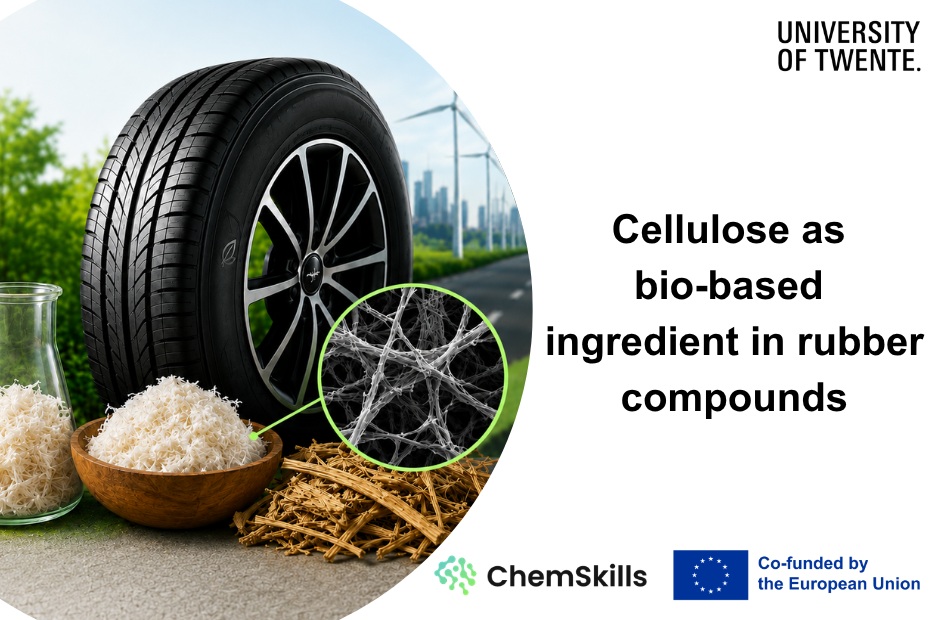
Exploring one of the most promising applications of the bio based material previously identified, this training module examines the use of cellulose as a sustainable ingredient in rubber compounds, with a particular focus on the tire industry.
In fact, the tire industry is currently facing new sustainability challenges, especially regarding the replacement of fossil-based raw materials. Leading tire manufacturers have publicly outlined their timelines and strategies for integrating sustainable raw materials, such as recycled and bio-derived components, into their products, with most targeting 40 to 100% sustainable raw materials by 2030, and full sustainability or net zero emissions by 2050.
In this context, cellulose, especially in its nanometric forms, shows great potential as a sustainable filler in tires, thanks to its bio derived nature and suitable particle dimensions.
This free online training module is organized into 5 sections: from mixing and processing (with a focus on compatibility and dispersion), through tensile and dynamic-mechanical properties, to other relevant properties, and finally safety and hazard.

