Text size
Line height
Text spacing
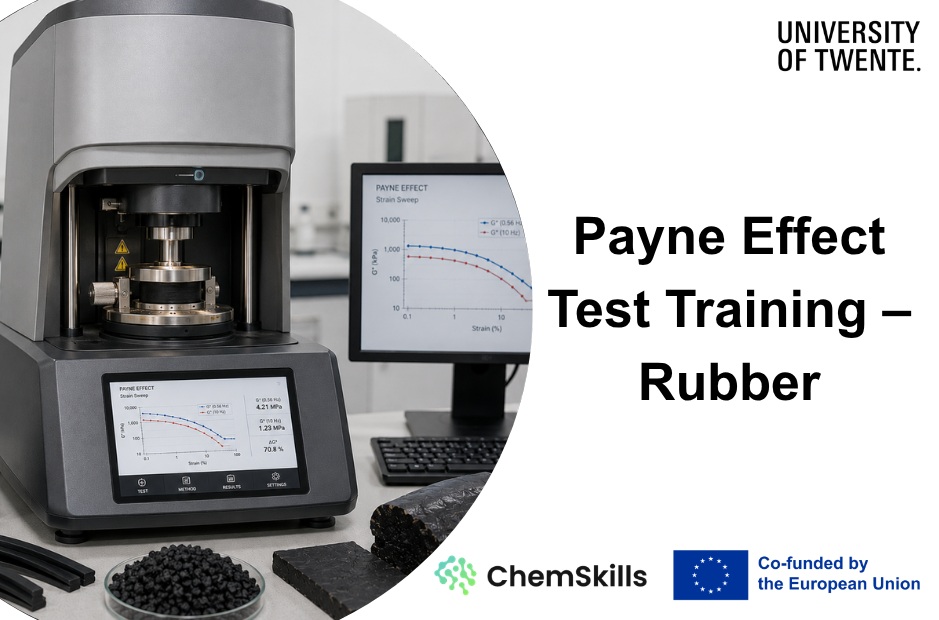
Filler clusters inside a rubber compound don't just sit passively, they form networks that break down under strain, and how easily that happens says a lot about compound quality. The Payne effect captures exactly this behavior.
In this training module, you will learn how the storage modulus of a filled rubber compound drops as strain amplitude increases, and why this reveals filler dispersion, filler-polymer interaction, and network structure. You will discover how to run a strain-amplitude sweep on a Rubber Process Analyzer, and how to distinguish the Payne effect in uncured versus cured compounds.
You will also learn how to export your results and interpret them, using the strength of the effect to judge mixing quality, dispersion, and reinforcement.
Filler clusters inside a rubber compound don't just sit passively, they form networks that break down under strain, and how easily that happens says a lot about compound quality. The Payne effect captures exactly this behavior.
In this training module, you will learn how the storage modulus of a filled rubber compound drops as strain amplitude increases, and why this reveals filler dispersion, filler-polymer interaction, and network structure. You will discover how to run a strain-amplitude sweep on a Rubber Process Analyzer, and how to distinguish the Payne effect in uncured versus cured compounds.
You will also learn how to export your results and interpret them, using the strength of the effect to judge mixing quality, dispersion, and reinforcement.

